
Science Class 7 Chapter 11 Question Answer Light Shadows and Reflections
Light Shadows and Reflections Class 7 Question Answer (InText)

 is written on an ambulance. It reads ‘AMBULANCE’ when viewed from the rear-view mirrors of the vehicle ahead of the ambulance. (Page 162)
NCERT Class 7 Science Chapter 11 Question Answer Light Shadows and Reflections (Exercise)
Let Us Enhance Our Learning
| Column A | Column B |
| (i) Pinhole | (a) Blocks light completely camera |
| (ii) Opaque object | (b) The dark region formed behind the object |
| (iii) Transparent object | (c) Forms an inverted image |
| (iv) Shadow | (d) Light passes almost completely through it |
Answer:
| Column A | Column B |
| (i) Pinhole | (c) Forms an inverted image |
| (ii) Opaque object | (a) Blocks light completely camera |
| (iii) Transparent object | (d) Light passes almost completely through it |
| (iv) Shadow | (b) The dark region formed behind the object |

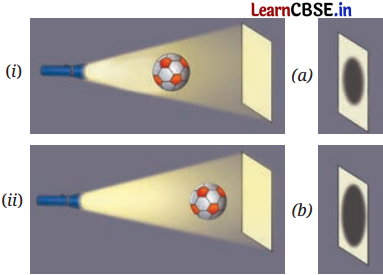
| Column A | Column B |
| (i) If the torch is close to the ball | (a) The shadow would be smaller |
| (ii) If the torch is far away | (b) The shadow would be larger |
| (iii) If the ball is removed from the set-up | (c) Two shadows would appear on the screen |
| (iv) If two torches are present in the set-up on the left side of the ball | (d) A bright spot would appear on the screen |
Answer:
| Column A | Column B |
| (i) If the torch is close to the ball | (b) The shadow would be larger |
| (ii) If the torch is far away | (a) The shadow would be smaller |
| (iii) If the ball is removed from the set-up | (d) A bright spot would appear on the screen |
| (iv) If two torches are present in the set-up on the left side of the ball | (c) Two shadows would appear on the screen |

(ii) This happens because, at 12 PM, the Sun is at its highest point in the sky, so the angle between the Sun and the ground is almost 90 degrees, casting a shorter shadow.

Class 7 Light Shadows and Reflections Question Answer (Activities)
Activity 11.1: Let Us Investigate (Page 155)

Fig. 11.4: Matchbox activity light through holes
Observation and conclusion: When all three matchboxes are placed in a straight line, with holes at the same height and properly aligned, the light from the torch passes through all the holes and a bright spot appears on the screen placed on the opposite side. This proves that light travels in a straight line. However, when the holes are not in a straight line, the light cannot pass through, and no spot is seen on the screen.
Activity 11.2: Let Us Explore (Page 155)

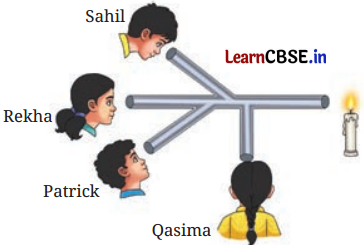
Fig. Viewing candle flame through, (a) a straight pipe (b) a bent pipe
Observation and conclusion: We are able to see the candle flame through a straight pipe, as shown in fig. 11.5 (a), but not through a bent pipe, as shown in fig. 11.5 (b), because light travels in a straight line.
Activity 11.3: Let Us Experiment (pages 156-157)

Table 11.1: Light through different materials
| Material Cardboard | Transparent/ Translucent/Opaque | Light will pass fully/partially/not at all | |
| My prediction | My observation | ||
| Paper | Opaque | Not at all | Not at all |
| Glass | Opaque | Not at all | Not at all |
| Tracing | Transparent | Fully | Fully |
| paper | Translucent | Partially | Partially |
| Thick cloth | Opaque | Not at all | Not at all |
| Wax paper | Translucent | Partially | Partially |
| Water | Transparent | Fully | Fully |
Observation and conclusion: Transparent materials allow light to pass through them completely, so we can see clearly through them. Translucent materials allow some light to pass through them, so we can see partially through them. Opaque materials do not allow light to pass through them, so we cannot see through them.
Activity 11.4: Let Us Explore (Pages 158-159)
Table 11.2: Observation of shadows
| Action | Observations regarding shadow |
| The screen is removed. | Shadow cannot be seen |
| The object is removed. | No shadow is formed |
| The torch is switched off. | No shadow is formed |
| The object is moved closer to the screen, keeping the torch and the screen fixed. | Shadow becomes smaller |
| The object is moved closer to the torch, keeping the torch and the screen fixed. | Shadow becomes larger |
| The object is tilted, keeping the torch and the screen fixed. | Shape of shadow changes |
| The colour of the object is changed. | Colour of shadow does not change |
Observation and conclusion: A shadow is formed when an opaque object blocks the path of light. The source of light, opaque object, and screen are necessary for the formation of a shadow. Changing the colour of the object does not affect the colour of the shadow. The position of the object affects the size and shape of the shadow:
- If the object is moved closer to the screen, the shadow becomes smaller.
- If the object is moved closer to the light source, the shadow becomes larger.
- Tilting the object changes, the shape of the shadow.
Activity 11.5: Let Us Investigate (Pages 159-160)

Fig. Using mirror to redirect sunlight on a wall.
Observation and conclusion: When a shiny flat steel plate or mirror is tilted in different directions, we can see a spot of light on the wall or a nearby surface.
When we change the angle of the mirror or plate, the direction of the light also changes. This happens because the shiny surface or mirror changes the direction of the light that falls on it and this change in the direction of light by the mirror or shiny surface is known as reflection of light.
Activity 11.6: Let Us Experiment (Page 160)

Fig. (a) A light beam (b) Reflection of light in a plane mirror.
Observation and conclusion: When a narrow beam of light passes through a small slit and falls on a white sheet, it travels in a straight path, as shown in Fig.(a). However, when a plane mirror is placed in the path of this light beam, the direction of the beam changes, as shown in Fig. (b). This change in the direction of light when it strikes a shiny surface like a mirror is called reflection of light.
Activity 11.7: Let Us Experiment (Page 161)

Fig. Image of a pen in a plane mirror.
Observation and conclusion: In the plane mirror, image is formed behind the mirror and is of the same size as the object. The image formed by a plane mirror is always erect (upright) in nature. However, the image formed by a plane mirror cannot be obtained on the screen.
Activity 11.8: Let Us Experiment (Pages 161-162)

Fig. Observing one’s own image in a mirror.
Observation and conclusion: In a plane mirror, the image is formed at the same distance behind the mirror as the object is in front of it. If the object is closer to the mirror, the image will also be closer. If the object is far from the mirror, the image will also appear far. In a plane mirror, the right appears as left and left appears as right; this is due to lateral inversion.
Activity 11.9: Let Us Explore (Page 163)

Observation and conclusion: When we place a lighted candle in the front of a cardboard with a small hole, as shown in fig. (a), the light coming from the flame passes through the hole and forms an inverted (upside-down) image of a candle on the screen behind the cardboard, as shown in fig. (b).





0 Comments