NCERT Class 6 Social Science SST Chapter 4 Timeline and Sources of History Questions and Answers Solutions
Timeline and Sources of History Class 6 Questions and Answers (In-Text)
The Big Questions (Page 59)
Question 1.
How do we measure historical time?
Answer:
(a) BC: The letters BC means Before Christ: Dates are generally counted (i.e., the day, the month and the years) or assigned to the birth of Jesus Christ, the founder of Christianity so 2000 BC means 2000 years before the birth of Jesus Christ. All dates before the birth of Jesus Christ are counted backwards and generally have the letter BC or BCE (Before Christ) added on.
(b) AD: We sometimes find AD before dates. This stands for two Latin words, “Anno Domini”, and mean in the year of the lord (i.e., Jestrs Christ). For example, 2008 can also be written as AD 2008 or 2008 AD or 2008 CE.
(c) CE: Sometimes, CE is used instead of AD. The letters CE stands for ‘Common Era’.
(d) BCE: Sometimes BCE is used instead of BC. The letters BCE stands for ‘Before Common Era’. We use these terms because the Christian Era is now used in the most countries of the world.
(e) Script: Way .or style of writing of a language is called a script. It consists of letters or signs. For example, ‘Devnagri’ is a script of Hindi.

Question 2.
How can various sources help us understand history?
Answer:
Various sources, like old buildings, written records, stories, old coins, etc., help us learn about the past. These sources tell us about the lives of the people and the social structure of that particular time; not only this, these sources also tell us about their culture, the type of material that was used and many other things are revealed by studying these sources carefully.
Question 3.
How did early humans live?
Answer:
Early humans, also known as Paleolithic humans, lived during the Old Stone Age, which spanned from approximately 2.5 million to 10,000 years ago.
(a) Nomadic Hunter-gatherers: They traveled in small groups, following animals and seasonal food sources. They hunted animals, gathered fruits, nuts, and plants, and fished.
(b) Shelters: They constructed simple shelters using natural materials like branches, animal hides, and stones.
(c) Tools: They created stone tools, like flint knives, hand axes, and scrapers, to aid in hunting and processing food.
(d) Clothing: They likely wore animal hides, furs, and woven fibers for clothing and protection.
Let’s Explore
Question 1.
Such calculations are simple, but there is a catch. In the Gregorian calendar, there is no ‘year zero’. The year 1 CE follows immediately the year 1 BCE . Draw a simple timeline marking every year from 2 BCE to 2 CE ; you will see that because of the absence of a year zero, only 3 years have passed between those two dates. (Page no. 63)
Answer:
Question 2.
So to calculate the number of years between a BCE date and a CE date, you should add them but subtract 1- in the above case, 2 + 2 – 1 = 3.
Answer:
Do it yourself
Question 3.
Create a timeline stretching from 1900 CE to the current year and place the dates of birth of your grandparents, parents, siblings and yourself. Also, mark the years that the 20th century CE begins with and ends with. (Page no. 65)

Key Points on the Timeline
- 1900 CE: Start of the 20th century.
- 1950 CE: Birth of your grandparent.
- 1975 CE: Birth of your parent.
- 2000 CE: End of the 20th century.
- 2005 CE: Birth of your sibling.
- 2010 CE: Birth of yourself.
- 2024 CE: Current year
Question 4.
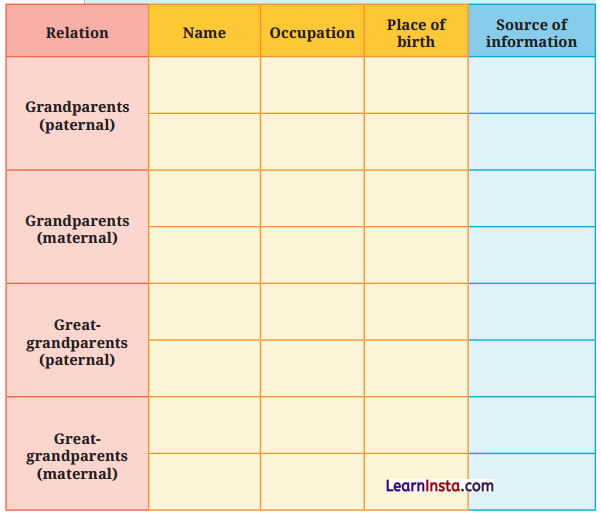
Can you collect information about at least three generations of your family on your mother’s and father’s sides? Create a family tree with your parents, grandparents and great-grandparents. Find out their names, what they did for a living and where they were born. Also, write the sources from where you got this information. (Page no. 66)
Answer:
Do it yourself.
Question 5.
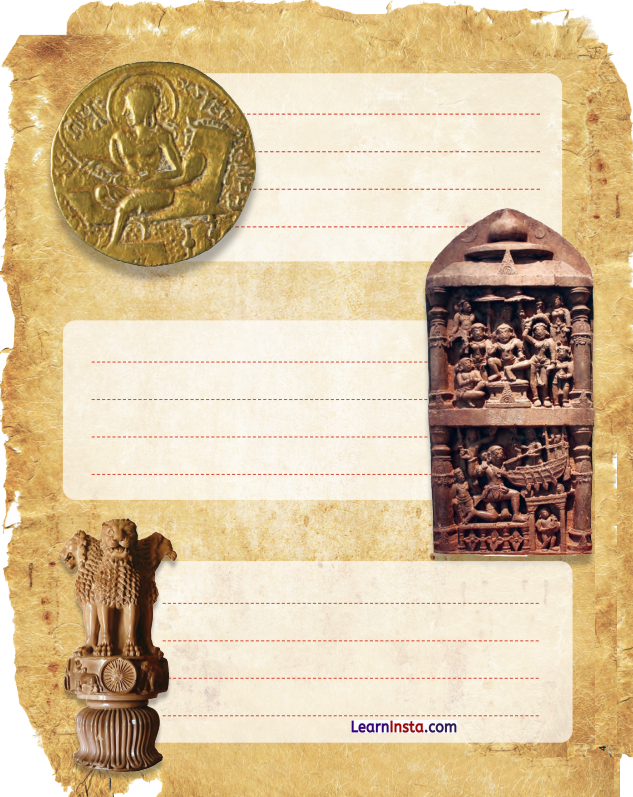
There are a few images of different sources of history on the next page. Who and what do you think the objects show? Write down in the boxes next to the images any information that you get from these objects. (Page no. 68)
Answer:
Do it yourself.
Question 6.
There are a few images of different sources of history on the next page. Who and what do you think the objects show? Write down in the boxes next to the images any information that you get from these objects. (Pages 68 & 69)
Answer:
(a) The Samudragupta veena coin showcases a rich cultural and artistic symbolism from the Gupta Empire. It prominently features the emperor, Samudragupta, playing a veena, a traditional Indian musical instrument.
This depiction highlights his patronage of the arts and his personal involvement in music, reflecting the Gupta Empire’s appreciation for cultural achievements. The coin not only represents the emperor’s sophistication but also symbolizes the prosperity and cultural richness of his reign, marking a golden age in Indian history.
(b) A 12th-century hero stone depicting a naval battle is a significant historical artifact that offers valuable insights into the martial and maritime traditions of the time. Hero stones, or “virakals” in Kannada, are commemorative monuments often erected to honor warriors who died in battle.
(c) The Lion Capital of Ashoka is one of the most famous and iconic artifacts from ancient India. It was originally erected atop a column by Emperor Ashoka the Great at Sarnath, near Varanasi. This capital is now housed in the Sarnath Museum.
Question 7.
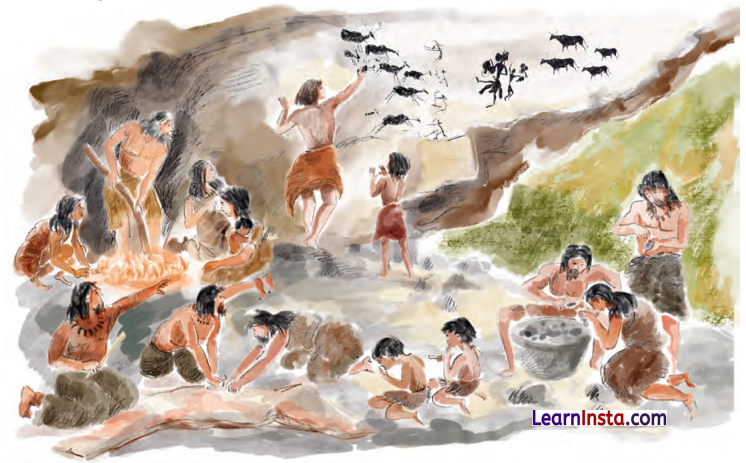
In the below picture, look at some activities of early humans in a rock shelter. Which ones can you recognise? Give a brief description for each. (Page, 70)
Answer:
Some activities of early humans in a rock shelter are:
(i) Many rock shelters feature ancient cave paintings or carvings. These artworks often depict animals, hunting scenes, and abstract symbols, reflecting early humans’ cultural and spiritual beliefs.
(ii) Early humans used fire for cooking food, which made it easier to digest and safer to eat.
(iii) Early humans made tools from stone, bone, and wood for hunting, gathering, and daily tasks. Rock shelters provided a convenient location for crafting and repairing tools.
Question 8.
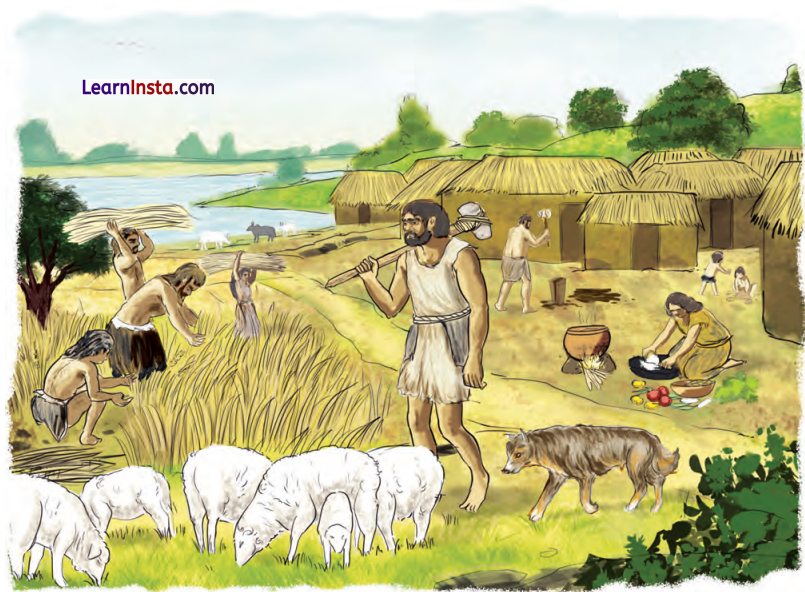
Observe the scene on the below picture. It depicts an agricultural community from a few millenniums ago. List the main activities you can identify. (Pages 70 & 71)
Answer:
The main activities as observed in the picture are domestication of animals, cooking, making tools, and grain harvesting.
Timeline and Sources of History Question Answer (Exercise)
Question 1.
Can we compare historians to detectives? Give reasons for your answers.
Answer:
Yes, historians can be compared to detectives. Due to the following reasons:
(i) Investigate Evidence: Just like detectives look for clues at a crime scene, historians examine old documents, artifacts, and other evidence to uncover the past.
(ii) Ask Questions: Detectives ask questions to solve mysteries. Historians also ask questions to understand why and how events happened in history.
(iii) Piece Together Information: Detectives gather bits of information to solve a case. Historians put together different pieces of evidence to build a complete picture of historical events.
(iv) Solve Mysteries: Detectives solve crimes by figuring out what happened. Historians solve historical mysteries by finding out what life was like in the past and how events shaped the world.
(v) Use Clues Wisely: Detectives use clues to make sense of a case. Historians use historical clues to draw conclusions about past societies and cultures.
Question 2.
A few exercises with dates:
(a) Place these dates chronologically on the timeline: 323 CE, 323 BCE, 100 CE, 100 BCE, 1900 BCE, 1090 CE, 2024 CE.
Answer:
(b) If King Chandragupta was born in 320 CE, which century did he belong to? And how many years was that after the Buddha’s birth?
Answer:
King Chandragupta, born in 320 CE , belonged to the 4 th century CE. To determine how many years after the Buddha’s birth this was, we first need to account for the time between Buddha’s birth in 560 BCE and the start of the Common Era. This period spans 560 years. Next, we calculate the years from 1 CE to 320 CE , which is 319 years. Adding these two periods together gives a total of 879 years. Therefore, King Chandragupta was born 879 years after the Buddha’s birth.
(c) Rani of Jhansi was born in 1828. Which century did she belong to? How many years was that before India’s Independence?
Answer:
Rani of Jhansi, born in 1828, belonged to the 19th century. To determine how many years before India’s Independence she was born, we need to subtract her birth year from the year of Independence. India gained Independence in 1947. Calculating the difference, we find that 1947 minus 1828 equals 119 years. Therefore, Rani of Jhansi was born 119 years before India gained its Independence.
Activities :
Plan a visit to a nearby museum: the visit should be prepared with some prior research on the kind of exhibits the museum holds. Keep notes during the visit. Write a brief report afterwards, highlighting what was unexpected/interesting/fun about the visit and the exhibits.
Invite to your school an archaeologist or a historian and ask them to speak on the history of your region and why it’s important to know it.
Project :
As a project, write the history of your family (or village if you live in one), using sources of history at your disposal. Ask your teacher to guide you.








0 Comments