NCERT Class 7 Social Science Chapter 3 Climates of India Questions and Answers Solutions
Climates of India Class 7 Question Answer (In-Text)
The Big Questions? (Page 45)
Question 1.
What makes India’s climate so diverse?
Answer:
India’s climate is diverse because of its vast size, different landforms, and location near the Tropic of Cancer. It has many climate types, including tropical, desert, and mountainous. The Himalayas block cold winds, while the monsoons bring seasonal rainfall, making the climate diverse.
Question 2.
What are the monsoons? How are they formed? (Page 45)
Answer:
Monsoons are seasonal winds that bring heavy rainfall to India. They are formed due to the heating of land and water. In summer, the land heats up quickly, drawing in moist winds from the Indian Ocean, causing rainfall. In winter, the land cools, and dry winds blow from land to sea, bringing little rain.
Question 3.
What is the effect of climate on economy, culture and society? (Page 45)
Answer:
Effect of climate on economy, culture, and society are as follows:
(i) Economy: Climate affects farming, fishing, tourism, and other jobs. For example, in warm and sunny places, people can grow crops like rice and cotton. But in very cold or dry areas, farming is harder, and people may do other jobs like herding animals or working in factories.
(ii) Culture: Climate influences what people wear, eat, and how they live. In cold places, people wear thick clothes and build warm houses. In hot areas, clothes are light and houses are made to stay cool. Local festivals and traditions also depend on the weather and seasons.
(iii) Society: Climate affects where people live and how they interact. In harsh climates, fewer people live there. In comfortable climates, more people settle. Natural disasters like floods or droughts can make people move to safer places and change their way of life.

Question 4.
How can understanding the climate help us to prepare for natural disasters? (Page 45)
Answer:
Understanding the climate helps us prepare for natural disasters like floods, droughts, and cyclones. It allows people to plan farming, build strong houses, and set up early warning systems. Knowing weather patterns helps in reducing damage and saving lives.
Question 5.
What is climate change? What are its consequences? (Page 45)
Answer:
Climate change means a big change in the Earth’s normal weather over a long time. It is mostly caused by pollution from cars, factories, cutting down trees, and burning fuels like coal and oil. This adds more gases (like carbon dioxide) to the air, which makes the Earth warmer. Consequences of Climate Change:
- Rising temperatures: The Earth is getting hotter, which can cause heatwaves.
- Melting ice: Ice in the polar regions is melting, causing sea levels to rise.
- More natural disasters: There are more floods, storms, and droughts.
- Harm to animals: Some animals lose their homes and food, like polar bears.
- Effect on people: Farmers may not grow enough food, and some people may have to leave their homes.
Let’s Explore (Page 47)
Question 1.
Which are your favourite seasons? Write a short essay explaining your reasons.
Answer:
Do it yourself.
Question 2.
Discuss in groups of three or four and find out whether there are specific events connected to the seasons in your region. Collect information about them songs, feasts with specific types of food, practices in different seasons, etc. Document these and share your discoveries with your class. (Page 47)
Answer:
Do it yourself.
Question 3.
Do you know which trees in your area change colours before the onset of winter? Are there trees that shed their leaves around this time? Why do you think this happens? Find out and document the local names of these trees.(Page 47)
Answer:
Some trees change the colour of their leaves before winter, while others shed their leaves completely. In many regions of India, trees like Peepal, Neem, and Gulmohar shed their leaves in winter. This happens because trees prepare for the cold and dry season by reducing water loss. Shedding leaves helps them survive harsh weather by conserving energy and moisture.
The local names of trees that shed their leaves vary by region. For example:
- Peepal: Known as Arasa Maram in Tamil, Pippal in Hindi
- Neem: Called Veppa Maram in Tamil, Nimba in Marathi
- Gulmohar: Known as Mayflower tree in English, Krishna Chura in Bengali
Nature follows this cycle to help trees rest during unfavourable conditions and grow fresh leaves when the climate improves.
Question 4.
Udhagamandalam (Ooty) and Coimbatore are almost at the same latitude. The range of summer temperatures in Ooty is 10-25°C while that in Coimbatore is 25-38°C. Why do you think there is such a difference in temperature between these two places? (Page 51)
Answer:
Even though Ooty and Coimbatore are at almost the same latitude, their temperatures differ due to altitude.
- Ooty is located at a higher altitude (about 2,240 meters above sea level) in the Nilgiri Hills, leading to a cooler climate throughout the year.
- Coimbatore is at a much lower altitude (about 400 meters above sea level) in the plains, resulting in hotter summers.
- As altitude increases, the temperature decreases. This is because the air at higher altitudes is less dense and holds less heat.
- In general, temperature drops by about 6.5°C for every 1,000 meters of elevation gain. Thus, even though they are at the same latitude, Ooty is much cooler than Coimbatore due to its higher elevation.
Question 5.
Since the ability to predict the monsoon rainfall has been an important aspect of life in India, our ancestors observed Nature around them carefully. They developed local traditional knowledge through their experience. This traditional knowledge is an important heritage we must preserve. For example, fishermen on the Konkan coast predict the onset of the monsoon when fishes that normally stay under water are seen at the surface; in parts of southern India monsoon is said to arrive within 50 days after the Golden Shower tree (Cassia fistula) blossoms. Some communities also believe that when crows build their nests high on tree-tops, it indicates less rainfall, whereas if the nests are lower, rainfall is likely to be heavy. Make a list of such local knowledge about rain, fog, snow or hail in your area. (Page 56)
Answer:
Here are some examples (you can add local ones too):
- Ants coming out in large numbers: It is believed that when ants come out in large groups, it may rain soon.
- Frogs croaking loudly: If frogs are very noisy, it is often a sign that rain is coming.
- Clouds around the moon at night: A ring around the moon is said to be a sign of coming rain.
- Very red sky during sunset: It is sometimes believed that this means there may be no rain the next day.
- Chirping of birds early in the morning: Clear and loud bird calls can mean clear weather.
- Sudden drop in temperature in the morning: People say it may mean fog or dew will appear soon.
- Black butterflies flying around: Some believe this is a sign that it will rain soon.
Question 6.
Reach out to your grandparents or elders in your neighbourhood. Ask them about the traditional festivals and dances they remember from their childhood and youth, especially those related to agriculture and rain. What rituals did they participate in? Then organize a cultural fest with your friends. You can showcase some of the dances, songs, and activities your elders shared with you. Whether it is a dance, harvest ritual, or a simple story about prayer to rain gods, try to bring these traditions to life for your classmates. (Page 56)
Answer:
Do it yourself.
Question 7.
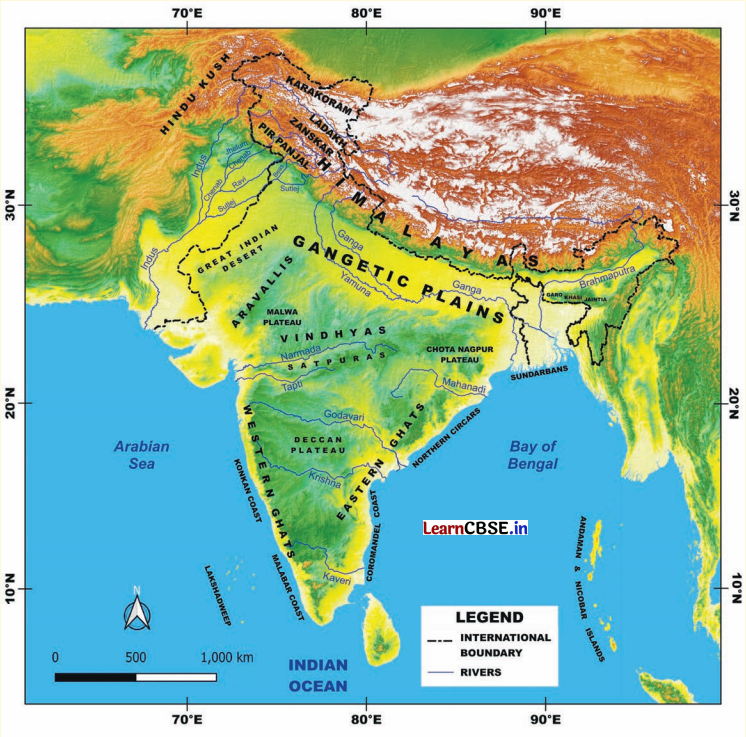
Have you seen or read about floods? Look at the physical map of India. Discuss in pairs why you think floods occur in the areas like Uttar Pradesh, Bihar, Kerala, Andhra Pradesh and Assam. (Page 60)
Answer:
Do it yourself.
Question 8.
Observe the below figure and answer the questions that follow: (Page 62)
(i) Identify the type of disaster and describe the effects they may have on people, plants, animals and economic life. (Page 62)
Answer:
The effects of the disasters on people, plants, animals and economic life are as follows: Cyclones can have devastating effects on people, plants, animals, and the economy. For people, cyclones cause injuries, fatalities, and displacement from their homes. The strong winds and heavy rainfall can destroy crops and trees, severely affecting plant life. Animals lose their habitats, and many may perish due to the storm’s intensity. Economically, cyclones cause widespread damage to agriculture, coastal infrastructure, and industries, leading to significant losses and long-term recovery efforts.
Floods pose a serious threat to people by causing . displacement, injury, and death. Floodwaters often lead to outbreaks of waterborne diseases, affecting public health. For plants, floods can wash away crops and erode fertile soil, leading to agricultural losses. Animals are also at risk, with many losing their habitats and livestock perishing. The economy suffers from crop failures, damage to homes and infrastructure, and the high cost of recovery and rebuilding efforts.
Landslides result from the sudden movement of earth, which can lead to significant destruction. For people, landslides can cause injury, loss of life, and the displacement of entire communities. The force of the landslide destroys plants and crops, leaving large areas of land barren. Animals lose their habitats, and many perish in the destruction. Economically, landslides can disrupt transportation, damage infrastructure, and affect agricultural productivity, leading to long-term financial strain. Forest fires can cause widespread destruction to both the environment and human life.
People suffer from health issues due to smoke inhalation, and many may lose their homes. Forest fires decimate plants, destroying forests and leading to soil degradation. Animals are often killed or displaced, losing their natural habitats. Economically, forest fires impact timber production, tourism, and the overall environmental health of a region, resulting in substantial economic losses.
(ii) In groups of four or five, identify in each of the above disasters the part of natural causes and the part of human causes. Compare your conclusions.
Answer:
Do it yourself.
(iii) Discuss in the same groups series of preventive measures that could help avoid the above disasters.
Answer:
Do it yourself.
Think About it
Question 1.
What are clouds? and what are they made of? (Page 59)
Answer:
Clouds look like white or grey lumps in the sky, but do you know what they are made of? They are made of water! But not the water we drink clouds are made of tiny water droplets or ice crystals that float high up in the sky. These droplets are so small and light that they stay in the air and form clouds.
Class 7 SST Chapter 3 Climates of India Question Answer (Exercise)
Question 1.
Match the climatic factors with their effects:
| Column A | Column B |
| 1. Latitude | (a) Brings wet air to India during summer |
| 2. Altitude | (b) Creates different climates in the north and south |
| 3. Proximity to the ocean | (c) Keeps higher places cooler |
| 4. Monsoon winds | (d) Moderates the temperature |
Answer:
| Column A | Column B |
| 1. Latitude | (c) Keeps higher places cooler |
| 2. Altitude | (d) Moderates the temperature |
| 3. Proximity to the ocean | (a) Brings wet air to India during summer |
| 4. Monsoon winds | (d) Moderates the temperature |
Question 2.
Answer the following questions:
(i) What is the difference between weather and climate?
Answer:
Weather refers to the short-term atmospheric conditions of a place, while climate is the long-term average of weather patterns over many years.
(ii) Why do places near the ocean have milder temperatures than places far away from it?
Answer:
Places near the ocean have milder temperatures because the ocean moderates the temperature, preventing extreme heat in summer and severe cold in winter.
(iii) What role do monsoon winds play in affecting India’s climate?
Answer:
Monsoon winds bring wet air to India during summer, causing heavy rainfall and influencing the overall climate of the region.
(iv) Why is Chennai warm or hot throughout the year, while Leh is cold?
Answer:
Chennai remains hot throughout the year because of its proximity to the ocean, which keeps temperatures stable, while Leh is cold because it is at a high altitude, making it cooler.
Question 3.
Look at a map of India given below. Identify the climate for these cities Leh, Chennai, Delhi, Panaji and Jaipur.
• Is the place near the sea, near the mountains, or in the desert?
• How do these factors affect the climate there?
Answer:
Here is the climate classification and geographical influence for each city:
Leh
- Location: Near the Himalayas, high altitude
- Climate: Cold and dry
- Effect: High altitude keeps it cold throughout the year, and it receives very little rainfall.
Chennai
- Location: Coastal, near the Bay of Bengal
- Climate: Hot and humi
- Effect: The ocean moderates the temperature, keeping summers very hot but winters mild with high humidity.
Delhi
- Location: Inland, near the northern plains
- Climate: Extreme – very hot summers and cold winters
- Effect: Being far from the sea causes large temperature variations between seasons.
Panaji
- Location: Coastal, near the Arabian Sea
- Climate: Moderate, warm, and humid
- Effect: The sea breeze keeps temperatures moderate with heavy monsoon rains in summer.
Jaipur
- Location: Inland, near the Thar Desert
- Climate: Hot and dry
- Effect: The desert causes extremely hot summers and dry winters with little rainfall.
Question 4.
Draw the monsoon cycle in summers and winters on a map of India.
• Label where the winds blow in summer and winter.
• Show the direction of winds during the monsoon.
Answer:
Do it yourself.
Question 5.
Make a colourful poster showing festivals in India linked to farming and weather (e.g., Baisakhi, Onam). Add pictures or drawings of these festivals.
Answer:
Do it yourself.
Question 6.
Imagine you are a farmer in India. Write a short diary entry about how you would prepare for the rainy season.
Answer:
Diary Entry – Preparing for the Rainy Season June 10, 2024 Dear Diary, The monsoon clouds are gathering, and I must start preparing my fields for the rainy season. First, I will plow the land to loosen the soil so that it can absorb water well. I have selected seeds for paddy and maize, as they grow best with plenty of rain. I must also clean the irrigation channels to prevent waterlogging and ensure the rainwater flows properly. My cattle need shelter, so I will reinforce the shed to keep them dry. I will also store food and firewood in case of heavy rains. I pray for good rains this year so that my crops grow well and bring a good harvest.
Question 7.
Identify a natural disaster (e.g., cyclone, flood, tsunami, landslide, or forest fire) and write a short essay that includes the causes and impacts. Suggest actions that individuals, communities and the government can take to reduce the impact.
Answer:
Floods are one of the most common natural disasters, occurring when excessive water overflows onto land that is usually dry. They are caused by heavy rainfall, river overflow, dam failure, or melting glaciers. In coastal areas, floods can also be triggered by storms and tsunamis.
Floods have severe impacts on people, property, and the environment. They destroy homes, roads, and farmlands, leaving many people homeless. Floodwaters contaminate drinking water, leading to diseases. The loss of crops and livestock affects food supply and the economy. Sometimes, floods also result in loss of lives and displacement of communities.
To reduce the impact of floods, individuals can avoid building houses in flood-prone areas and keep emergency supplies ready. Communities can build embankments, plant trees, and clean drainage systems to prevent waterlogging. The government should construct strong dams, improve weather forecasting, and provide relief to affected people. Proper planning and awareness can help reduce the destruction caused by floods.







0 Comments