Ganita Prakash Class 7 Chapter 5 Solutions Parallel and Intersecting Lines
NCERT Class 7 Maths Ganita Prakash Chapter 5 Parallel and Intersecting Lines Solutions Question Answer
5.1 Across the Line
NCERT In-Text Questions (Page 107)
Can two straight lines intersect at more than one point?
Solution:
No, two straight lines can only intersect at one point. If they are parallel, they never intersect. But if two lines appear to intersect at more than one point, it means they are the same.

Is this always true for any pair of intersecting lines?
Solution:
Yes. When two lines intersect, they form four angles at a point of intersection. The angles directly opposite each other at this point are called vertically opposite angles, and they are always equal in measure.
Figure it Out (Page 108)
List all the linear pairs and vertically opposite angles you observe from Figure:
Solution:
5.3 Between Lines
NCERT In-Text Questions (Pages 109-110)
Observe Figure and describe the way the line segments meet or cross each other in each case, with appropriate mathematical words (a point, an endpoint, the midpoint, meet, intersect) and the degree measure of each angle.
For example, line segments FG and FH meet at the endpoint F at an angle of 115.3°.
Are line segments ST and UV likely to meet if they are extended?
Solution:
If the lines are not parallel, they will likely intersect at some point. Thus, line segments ST and UV are likely to meet when extended, as they are not parallel.
Are line segments OP and QR likely to meet if they are extended?
Solution:
If two lines are parallel, they will never meet, regardless of how far they are extended. Thus, line segments OP and QR didn’t meet when extended, as they are parallel.
Which pairs of lines appear to be parallel in the Figure below?
Solution:
Two lines are said to be parallel when they do not meet at any point.
Here, lines a, i, and h are parallel to each other;
Line c is parallel to line g;
Line d is parallel to line f;
Line e is parallel to line b.
Figure it Out (Pages 113-114)
Question 1.
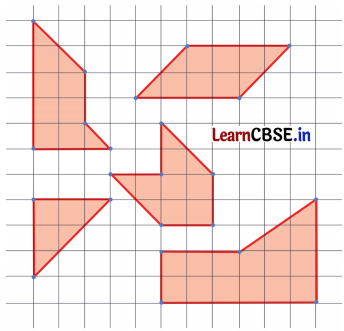
Draw some lines perpendicular to the lines given on the dot paper in the Figure.
Solution:
Do it yourself.
Question 2.
In the given figure, mark the parallel lines using the notation given above (single arrow, double arrow, etc). Mark the angle between perpendicular lines with a square symbol.
(a) How did you spot the perpendicular lines?
(b) How did you spot the parallel lines?
Solution:
(a) To spot perpendicular lines in a geometric figure, observe if lines intersect at a 90° angle.
(b) To spot parallel lines in a geometric figure, observe if lines never intersect at any point.
Question 3.
In the dot paper following, draw different sets of parallel lines. The line segments can be of different lengths but should have dots as endpoints.
Solution:
Do it Yourself.
Question 4.
Using your sense of how parallel lines look, try to draw lines parallel to the line segments on this dot paper.
(a) Did you find it challenging to draw some of them?
(b) Which ones?
(c) How did you do it?
Solution:
(a) – (c) Do it yourself
Question 5.
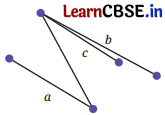
In the figure, which line is parallel to line a—line b or line c? How do you decide this?
Solution:
In the given figure, line a is parallel to line c because these two lines are always the same distance apart and never meet, no matter how far they go.
Figure it Out (Page 119)
Can you draw a line parallel to l, that goes through point A? How will you do it with the tools from your geometry box? Describe your method.
Solution:
Tools needed: Ruler, Set-squares (right-angled triangle), Pencil
Steps:
- Place the set square so that one side is along the line l.
- Hold the ruler against the other side of the set square (the ruler won’t move).
- Slide the set square along the ruler until one side reaches point A.
- Draw a line along the edge of the set square through point A.
- This new line is parallel to line l and passes through point A.
Making Parallel Lines through Paper Folding
NCERT In-Text Questions (Page 120)
Let us try to do the same with paper folding.
For a line l (given as a crease), how do we make a line parallel to l such that it passes through point A?
We know how to fold a piece of paper to get a line perpendicular to l.
Now, try to fold a perpendicular to l such that it passes through point A.
Let us call this new crease t.
Now, fold a line perpendicular to t passing through A again.
Let us call this line m.
The lines l and m are parallel to each other.
Why are lines l and m parallel to each other?
Solution:
Line t is perpendicular to line l; line m is also perpendicular to line t. Thus, if two lines are perpendicular to the same line, they are parallel to each other. Thus, lines l and m are parallel to each other because they share the same perpendicular relationship with line t.
Figure it Out (Pages 123-125)
Question 1.
Find the angles marked below.
Solution:
Since alternate interior angles formed by a transversal intersecting a pair of parallel lines are always equal to each other. Therefore, a = 48°.
Since alternate angles formed by a transversal intersecting a pair of parallel lines are always equal to each other. Therefore, b = 52°.
The sum of the interior angles on the same side of the transversal always adds up to 180°.
So, 180° – 99° = 81°. Therefore, c = 81°.
The sum of the interior angles on the same side of the transversal always adds up to 180°.
So, 180° – 81° = 99°. Therefore, d = 99°.
Alternate interior angles formed by a transversal intersecting a pair of parallel lines are always equal to each other. Therefore, e = 69°.
The sum of the interior angles on the same side of the transversal always adds up to 180°. So, 180°- 132° = 48°. Therefore, f = 48°.
Corresponding angles formed by a transversal intersecting a pair of parallel lines are always equal to each other. Therefore, g = 122°.
Alternate interior angles formed by a transversal intersecting a pair of parallel lines are always equal to each other. Therefore, h = 15°.
Alternate interior angles formed by a transversal intersecting a pair of parallel lines are always equal to each other. Therefore, i = 54°.
Alternate interior angles formed by a transversal intersecting a pair of parallel lines are always equal to each other. Therefore, j = 97°.
Question 2.
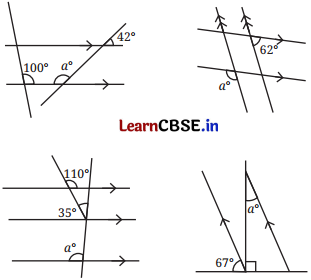
Find the angle represented by a.
Solution:
Here, ∠1 is 42°, so ∠2 is 180° – 42° = 138°, because ∠1 and ∠2 form a linear pair and linear pair always add up to 180°.
Now, since lines l and m are parallel and t is a transversal.
Therefore, ∠2 and a are alternate angles and equal.
Thus, a = 138°
Here, ∠1 is 62°, and ∠1 and ∠2 form a linear pair, and a linear pair always adds up to 180°.
So, ∠2 is 180° – 62°= 118°.
Now, ∠2 and ∠3 are corresponding angles, and equal lines l and m are parallel, and t is a transversal.
So, ∠3 = 118°
Now, ∠3 and a are corresponding angles and equal since lines s and t are parallel and line m is a transversal. Thus, a = 118°
Here, lines s and l are intersecting lines.
So, ∠1 = 110° [Vertically opposite angles]
And ∠1 = ∠2 = 110° because lines l and m are parallel and line s is a transversal.
Therefore ∠3 = ∠2 – 35° = 110° – 35° = 75°
Also, ∠3 = ∠4 = 75° [Corresponding angles]
So, a° = 180° – 75° = 105° [Linear pair angles]
Using angles on a straight line, we have
∠1 + ∠2 + 67° = 180°
∠2 = 180° – 67° – 90° = 23° [Since ∠1 = 90°]
Thus, a = 23° as ∠2 = ∠a [Alternate angles as lines l and t are parallel]
Question 3.
In the figures below, what angles do x and y stand for?
Solution:
Since lines 5 and m are perpendicular to each other.
So ∠2 = 90°
Now, ∠2 + 65° + x° = 180° [Linear Pair]
So, x° = 180° – 90° – 65° = 25°
Now, lines t and m are two intersecting lines.
So, x = ∠1 = 25°. [Vertically Opposite Angles]
Lines l and m are parallel to each other, and t is a transversal.
So, y° = ∠2 + 65° = 90° + 65° = 155° [Altemate angles]
Therefore, y = 155°.
Since lines l and m are parallel and line s is a transversal.
So, ∠3 = 78° [Alternate Angles]
Also, lines l and m are parallel, and line t is a transversal.
So, ∠1 = 53° [Alternate Angles]
Therefore, ∠2 = ∠3 – ∠1 = 78° – 53° = 25°
Lines s and t are intersecting lines.
Therefore, x° = ∠2 = 25° [ Vertically Opposite Angles]
Question 4.
In Figure, ∠ABC = 45° and ∠IKJ = 78°. Find angles ∠GEH, ∠HEF, ∠FED.
Solution:
Line segments IA and HC intersect at point B.
So, ∠ABC = ∠KBE = 45° [Vertically Opposite Angles]
Similarly, line segments JF and IA intersect at point K.
So, ∠IKJ = ∠BKE = 78° [Vertically Opposite Angles]
∠KBE = ∠GEH = 45° [Corresponding Angles]
Similarly, ∠BKE = ∠FED = 78° [Corresponding Angles]
Now, ∠GEH + ∠HEF + ∠FED = 180° [Linear Pair]
∠HEF = 180° – 45° – 78° = 57°
Question 5.
In the Figure, AB is parallel to CD, and CD is parallel to EF. Also, EA is perpendicular to AB. If ∠BEF = 55°, find the values of x and y.
Solution:
Given AB is parallel to CD and CD is parallel to EF.
So, AB is parallel to EF.
Now, EF is parallel to CD, and DE is a transversal.
So, y° + 55° = 180° [Sum of interior angles]
y = 125°
Now, AB is parallel to CD, and BD is a transversal.
So, x° =y° = 125° [Corresponding Angles]
Question 6.
What is the measure of angle ∠NOP in the given figure?
[Hint: Draw lines parallel to LM and PQ through points N and O]
Solution:
Draw a line RS through N, which is parallel to line LM, and line TU through O, which is parallel to line PQ.
∠LMN = ∠MNS [Alternate Angles]
Therefore, w° = 56°
Given, ∠MNO = 96°
w° + x° = 96°
x° = 96° – 40° = 56°
Now, RS is parallel to TU, and NO is a transversal.
So, ∠SNO = ∠NOT [Alternate Angles]
Therefore, y° = x° = 56°
Now TU is parallel to PQ, and OP is a transversal.
So, ∠TOP = ∠OPQ [Alternate Angles]
z° = 52° [Given ∠OPQ = 52°]
Thus, a° = y° + z° = 56° + 52° = 108°
Parallel Illusions
NCERT In-Text Questions (Page 125)
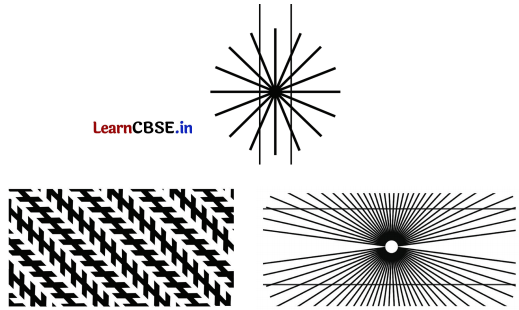
There do not seem to be any parallel lines here. Or, are there?
What causes these illusions?
Solution:
(a) At first glance, this image may appear to be a confusing mix of lines going in all directions, giving the impression that nothing is straight or parallel. However, if we take a closer look, we can see that the vertical lines are perfectly straight, evenly spaced, and are parallel. In contrast, the other lines in the image fan out like spokes on a wheel. These lines are not parallel; they are slanted and converge at a central point. Due to their orientation and the way they intersect with the vertical lines, our brains can become misled. This phenomenon is known as an optical illusion. It occurs because the slanted lines create a sensation that everything is angled or distorted. The focal point in the centre draws our attention and makes it difficult to concentrate on the vertical lines.
(b) This pattern appears to be filled with tilted or zigzagging lines, and the black shapes create a confusing background. However, if we look closely at the white spaces in between, we can see that the horizontal white lines are parallel. So why do they not seem that way? The bold, slanted black shapes visually interrupt the lines, causing our eyes to perceive them as slanting or shifting. This phenomenon is known as an optical illusion—our brain interprets the shapes around the lines, leading us to see something that isn’t there.
(c) When you first look at this picture, it appears that nothing is parallel. The lines seem bent, the shape appears to curve inward, and everything feels like it’s being pulled toward the centre. However, the two horizontal lines at the top and bottom of the image are parallel! This is a classic optical illusion. It occurs because of the many diagonal lines radiating from a central point, resembling the spokes of a wheel. These radiating lines distort our perception, leading our brains to interpret the space as curved due to the way the lines fan out from the centre, creating a sense of depth. As a result, the ends of the horizontal lines seem to bend, even though they are perfectly straight. This visual trick deceives our eyes into believing that the horizontal lines are curving inward, but if we measure them or place a ruler along them, we can see that they are straight and parallel.














0 Comments